

Apocalypse Resort
I assisted psychology professor Christopher Hawk in designing a game for use in experiments examining aggressive and prosocial behavioral outcomes. To do so, I designed a core game mode and created the main longform game design document, writing in accessible language to ease communication between interdisciplinary teams.
My Process
I. Getting Started
When I joined the Apocalypse Resort team, the project had been ongoing for years, but had run into several hiccups due to communication difficulties between researchers and designers. My main goal on the project was to bridge these departments by translating research questions into actionable design documentation.
To do so, I...
-
Wrote the main design document for the game, communicating across departments to ensure that the game, its mechanics, its experiment protocols, and the research objectives behind each design choice were easily understandable among different backgrounds
-
Playtested the current build of the game to revise design decisions
-
Designed the second core game mode
-
Compiled references for game mechanics and art direction choices
PRODUCTION
II. Research Creation Design
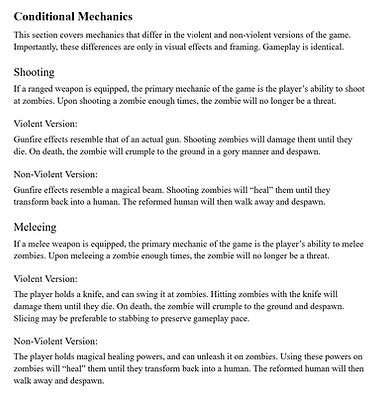
The core idea behind Apocalypse Resort is that the game features two different modes (violent and non-violent) that are identical gameplay-wise despite differing in visuals and framing. I joined the team when only the violent mode had been created, and therefore designed the non-violent mode to feature a 1:1 gameplay experience despite being framed as a prosocial game. I also designed a series of controllable variables, ranging from graphical realism, to competition modes, enemy aggression levels, difficulty levels, time levels, scripted wins and losses, and more, to account for different psychological testing scenarios.

Intro to My Design Document

Experiment Outline

Variable Creation
Designing Contextual Gameplay for Research

Compiling References


I Learned About:
1
Research-Based Design
I learned how to design a game while prioritizing research objectives over conventional design choices. At several points, I had to make design choices that go against traditional rules to make the game more "boring," as the experiment relied on players feeling as if they are experiencing a generic shooter. It taught me to think in different and unconventional ways.
2
Communication
The core challenge I worked to address on the project was that the researchers had trouble translating their ideas into actionable game design choices, or communicating their visions to designers. As someone with a foot in both doors, I learned to write and communicate design chioces and research goals in ways that are accessible for people of vastly different backgrounds.
3
Concise Documentation
Due to the importance of the game game design document for the team, I had to learn to structure, format, and write it in a manner that does not overwhelm or confuse interdisciplinary readers. To do so, I learned to cut ideas down to their most precise language, and included extensive hyperlinking, sectioning, and shortcuts to ensure team members could find exactly what they were looking for at any given time.